import warnings
warnings.simplefilter(action='ignore', category=FutureWarning)
Here Comes The Sun: Cebu Solar Power Plant
LT16 - Sandro Silva and Jac Lin Yu
Table of Contents
- 2.1. Loading Prerequisites
- 2.2. Dataset and Preprocessing
- 2.3. Train, Validation, Test Split and Batch Generation
- 2.4. Determining the Benchmark
- 2.5. Model Training and Selection
3. Results and Discussions * 3.1. Results * 3.2. Discussions and Recommendations
1. Problem Statement
In recent years, the global energy industry has changed its focus away from traditional fuel sources, such as oil and coal, to more alternative and sustainable solutions, such as hydroelectric, solar and wind. However, the shift towards renewable energy poses new threats and challenges to existing power grids across the world. One major concern surrounding renewable energy generation is the inherent variability and intermittency of its fuel source, as this can cause disruptions in power grids. Essentially, renewable energy technologies threaten to overwhelm the grid operators.
Renewable energy forecasting, in particular solar generation supply, may provide power grid operators the ability to predict and balance energy generation and consumption. In addition, power grid operators will be able to balance and schedule the distribution of generated power for not only renewable power plants but also conventional (and rigid) power plants, such as coal and natural gas.
2. Methodology
2.1 Loading Prerequisites
import numpy as np
import math
import pandas as pd
import matplotlib.pyplot as plt

from sklearn.preprocessing import MinMaxScaler

from tensorflow.keras.datasets import imdb
from tensorflow.keras.preprocessing import sequence
from tensorflow.keras.models import Sequential
from tensorflow.keras import layers
from tensorflow.keras.optimizers import RMSprop, Adam

from tensorflow.keras.callbacks import ModelCheckpoint, EarlyStopping
2.2 Dataset and Preprocessing
Here, we will load the already cleaned preprocessed dataset of solar generation per plant per hour. The cleaning was processed outside of this notebook, and followed a framework which follows the industry standard of imputing missing values.
To list a few processes: - using the average between the before(t-1) and after hour(t+1) - using a 1-week average of all similar intervals (ex, if empty during hour 6 of dec 20, take the moving average of all hour 6 from dec 13-dec19) - using a 4-week moving average of that specific hour and day of the week (ex, if empty during hour 6 of dec 20, we take average of hour 6(dec 13, 6, 29, 22)df = pd.read_excel('solar_dataset.xlsx',
sheet_name='cebu',
parse_dates=['DATETIME'])
Here let us observe the different datatypes, notice that some columns are objects, some of which will be dropped.
df.dtypesDATETIME datetime64[ns]
YEAR int64
MONTH int64
DAY int64
HOUR int64
RESOURCE_ID object
MW float64
Location object
Temperature float64
Dew Point float64
Humidity float64
Wind Speed float64
Wind Gust int64
Pressure float64
Condition object
Location_Name object
dtype: objectdf.head(3)| DATETIME | YEAR | MONTH | DAY | HOUR | RESOURCE_ID | MW | Location | Temperature | Dew Point | Humidity | Wind Speed | Wind Gust | Pressure | Condition | Location_Name | |
|---|---|---|---|---|---|---|---|---|---|---|---|---|---|---|---|---|
| 0 | 2016-12-26 00:00:00 | 2016 | 12 | 26 | 1 | 5TOLSOL_G01 | 0.0 | RPVM | 79.0 | 77.0 | 94.0 | 1.0 | 0 | 29.7 | Mostly Cloudy | MACTAN-CEBU |
| 1 | 2016-12-26 01:00:00 | 2016 | 12 | 26 | 2 | 5TOLSOL_G01 | 0.0 | RPVM | 82.0 | 79.0 | 89.0 | 5.0 | 0 | 29.8 | Mostly Cloudy | MACTAN-CEBU |
| 2 | 2016-12-26 02:00:00 | 2016 | 12 | 26 | 3 | 5TOLSOL_G01 | 0.0 | RPVM | 84.0 | 79.0 | 84.0 | 6.0 | 0 | 29.8 | Mostly Cloudy | MACTAN-CEBU |
It is customary in traditional time-series regression to convert the
month, day, hour into categorical data, which will be later used in one-hot encoding. In addition, this is the usual preprocessing used in the energy industry here in the Philippines.
df.MONTH = df.MONTH.astype('str')
df.DAY = df.DAY.astype('str')
df.HOUR = df.HOUR.astype('str')
Let us drop the unimportant columns
df.drop(['Location_Name', 'Location', "YEAR"],axis=1,inplace=True)
Let us append the main
df with the one-hot encoded dataframe
df = df.join(pd.get_dummies(df[['MONTH','DAY','HOUR','Condition']]))
Let us get the unique list of power plants in the region
locations = df.RESOURCE_ID.unique()
For this study, let us consider the first power plant
locations[0]'5TOLSOL_G01'df0 = df[df.RESOURCE_ID == locations[0]].copy()
Further dropping of columns as well as reordering of columns
df0 = df0.drop(['RESOURCE_ID','DATETIME','MONTH','DAY','HOUR','Condition'],
               axis=1)
df0 = df0[['Temperature','MW'] + df0.columns[2:].tolist()].copy()df0 = df0.astype('float')
Final
DataFrame to be used
df0.head()| Temperature | MW | Dew Point | Humidity | Wind Speed | Wind Gust | Pressure | MONTH_1 | MONTH_10 | MONTH_11 | ... | Condition_Partly Cloudy | Condition_Partly Cloudy / Windy | Condition_Rain | Condition_Rain / Windy | Condition_Rain Shower | Condition_Showers in the Vicinity | Condition_T-Storm | Condition_Thunder | Condition_Thunder / Windy | Condition_Thunder in the Vicinity | |
|---|---|---|---|---|---|---|---|---|---|---|---|---|---|---|---|---|---|---|---|---|---|
| 0 | 79.0 | 0.0 | 77.0 | 94.0 | 1.0 | 0.0 | 29.7 | 0.0 | 0.0 | 0.0 | ... | 0.0 | 0.0 | 0.0 | 0.0 | 0.0 | 0.0 | 0.0 | 0.0 | 0.0 | 0.0 |
| 1 | 82.0 | 0.0 | 79.0 | 89.0 | 5.0 | 0.0 | 29.8 | 0.0 | 0.0 | 0.0 | ... | 0.0 | 0.0 | 0.0 | 0.0 | 0.0 | 0.0 | 0.0 | 0.0 | 0.0 | 0.0 |
| 2 | 84.0 | 0.0 | 79.0 | 84.0 | 6.0 | 0.0 | 29.8 | 0.0 | 0.0 | 0.0 | ... | 0.0 | 0.0 | 0.0 | 0.0 | 0.0 | 0.0 | 0.0 | 0.0 | 0.0 | 0.0 |
| 3 | 84.0 | 0.0 | 77.0 | 79.0 | 7.0 | 0.0 | 29.7 | 0.0 | 0.0 | 0.0 | ... | 0.0 | 0.0 | 0.0 | 0.0 | 0.0 | 0.0 | 0.0 | 0.0 | 0.0 | 0.0 |
| 4 | 86.0 | 0.0 | 77.0 | 74.0 | 8.0 | 0.0 | 29.7 | 0.0 | 0.0 | 0.0 | ... | 0.0 | 0.0 | 0.0 | 0.0 | 0.0 | 0.0 | 0.0 | 0.0 | 0.0 | 0.0 |
5 rows × 99 columns
df0.shape(23160, 99)plant_capacity = 60
2.3 Train,Validate,Test Split and Batch Generation
For this analysis, a
.8, .1, .1, train-validate-test split was implemented. Since we are dealing with a time-series, the train-validate-test split cannot be randomly selected from the dataset, splitting of dataset should be conducted in a chronogical order. Below we define the starting and ending index for each group
train_validate_test_split = [.8, .1, .1]

train_idx = math.floor(df0.shape[0] * train_validate_test_split[0])
val_idx = math.floor(df0.shape[0] * train_validate_test_split[1]) + train_idx
The
generator function below was utilized to yield the appropriate batch. Significant parameters include the lookback, or how far back of the data to consider, delay, or how far into the future are we forecasting, batch_size, refers to the number of training examples utilized in one iteration.
def generator(data, lookback, delay, min_index, max_index, shuffle=False,
              batch_size=128, step=1):

    if max_index is None:
        max_index = len(data) - delay - 1
    i = min_index + lookback

    while 1:
        if shuffle:
            rows = np.random.randint(min_index + lookback,
                                     max_index, size=batch_size)
        else:
            if i + batch_size >= max_index:
                i = min_index + lookback
            rows = np.arange(i, min(i + batch_size, max_index))
            i += len(rows)

        samples = np.zeros((len(rows), lookback // step, data.shape[-1]))
        targets = np.zeros((len(rows),))
        for j, row in enumerate(rows):
            indices = range(rows[j] - lookback, rows[j], step)
            samples[j] = data[indices]
            targets[j] = data[rows[j] + delay][1]
        yield samples, targets
Let us mean-center the dataset
float_data = df0.values
train_mean = float_data[:train_idx].mean(axis=0)
float_data -= train_mean
train_std = float_data[:train_idx].std(axis=0)
float_data /= train_std
train_mw_std = train_std[1]
Let us initialize the parameters which will be used for the generation An industry standard practic is to utilize a
lookback of either 144 hours (1 week), 288 hours (2 weeks), or 720 hours (1[30-day] month). The initial run was to utilized a 288 hour lookback period due to group’s industry expert’s experience. However, outside consultation with industry experts said 1 week would suffice with this limited dataset.
lookback = 144 # lookback(consider) the previous week data
step = 1 # in hourly granularity
delay = 24 # to forecast the next 24 hours
batch_size = 128
train_gen = generator(float_data,
lookback=lookback,
delay=delay,
min_index=0,
max_index=train_idx,
shuffle=True,
step=step,
batch_size=batch_size)
val_gen = generator(float_data,
lookback=lookback,
delay=delay,
min_index=train_idx+1,
max_index=val_idx,
step=step,
batch_size=batch_size)
test_gen = generator(float_data,
lookback=lookback,
delay=delay,
min_index=val_idx,
max_index=None,
step=step,
batch_size=batch_size)
val_steps = (val_idx - (train_idx+1) - lookback)
test_steps = (len(float_data) - (val_idx+1) - lookback)
2.4 Benchmark
The team used two metrics to establish a baseline error:
(1) the naive method identified in a previous lecture, which we scaled to industry standard
(2) a different framework suggested by industry
def evaluate_naive_method():
batch_maes = []
for step in range(val_steps):
if step % 1000 == 0:
print(step)
samples, targets = next(val_gen)
preds = samples[:, -1, 1]
mae = np.mean(np.abs(preds - targets))
batch_maes.append(mae)
return np.mean(batch_maes)
naive_method = evaluate_naive_method()0
1000
2000print('NAIVE METHOD 1:', f'{((naive_method * train_mw_std)/plant_capacity):0.2%}') #where 22 is the capacity of the plantNAIVE METHOD 1: 7.67%benchmark1 = ((naive_method * train_mw_std)/plant_capacity) * 100 For establishing the 2nd baseline error, the team consulted the industry to determine a baseline error. However, even the industry is still conflicted on how to establish a baseline measurement. As of now, the baseline is still being established by policy makers and grid operators.
Luckily, consulting with industry experts gave the team a framework on how to establish a baseline error per plant. The resulting measure looked at the mean squared error of the day-ahead projection(DAP), also called scheduled (Ex-Ante or RTD), and the actual delivered (Ex-Post or RTX).
This was then scaled as a percentage to the capacity of the plant. This was with processed with an industry expert and not included in the notebook. The yielding error resulted with a baseline of15.34%
benchmark2 = 15.34
2.5 Model Training Selection
The team utilized 4 models:
- LSTM with 64 nodes
- LSTM with 32 nodes
- Stacked LSTM(2 layer) with 64 and 32 nodes
- Stacked LSTM(2 layer) with 32 and 64 nodes
Dropout of 0.2 and Recurrent Dropout of 0.2 and a RMSProp optimized was implemented for all three.
Epoch=50, with an EarlyStopping of patience=10 and min_delta=0.01 to avoid overfitting and to reduce runtime due to the limited time constraints.
steps_per_epoch_cnt = math.floor(train_idx/batch_size)
val_steps_cnt = round(math.floor((val_idx-train_idx)/batch_size),-1)
2.5.1 LSTM with 64
filepath_lstm64="Cebu_best_lstm64.hdf5"
cp_lstm64 = ModelCheckpoint(filepath_lstm64, monitor='val_loss', verbose=2, save_best_only=True, mode='min')
es_lstm64 = EarlyStopping(monitor='val_loss', mode='min', verbose=2, patience=10, min_delta=.01)
callbacks_list_lstm64 = [cp_lstm64, es_lstm64]

# fix random seed for reproducibility
seed = 1337
np.random.seed(seed)

model_lstm64 = Sequential()
model_lstm64.add(layers.LSTM(64,
                       dropout=0.2,
                       recurrent_dropout=0.2,
                       input_shape=(None, float_data.shape[-1])))
model_lstm64.add(layers.Dense(64,activation='relu'))
model_lstm64.add(layers.Dense(1))
model_lstm64.compile(optimizer=RMSprop(), loss='mae')

history_lstm64 = model_lstm64.fit_generator(train_gen,
                                        steps_per_epoch=steps_per_epoch_cnt,
                                        epochs=50,
                                        validation_data=val_gen,
                                        validation_steps=val_steps_cnt,
                                        callbacks=callbacks_list_lstm64, verbose=2)
WARNING:tensorflow:From /home/ssilva/anaconda3/lib/python3.7/site-packages/tensorflow/python/ops/resource_variable_ops.py:435: colocate_with (from tensorflow.python.framework.ops) is deprecated and will be removed in a future version.
Instructions for updating:
Colocations handled automatically by placer.
WARNING:tensorflow:From /home/ssilva/anaconda3/lib/python3.7/site-packages/tensorflow/python/keras/backend.py:4010: calling dropout (from tensorflow.python.ops.nn_ops) with keep_prob is deprecated and will be removed in a future version.
Instructions for updating:
Please use `rate` instead of `keep_prob`. Rate should be set to `rate = 1 - keep_prob`.
WARNING:tensorflow:From /home/ssilva/anaconda3/lib/python3.7/site-packages/tensorflow/python/ops/math_ops.py:3066: to_int32 (from tensorflow.python.ops.math_ops) is deprecated and will be removed in a future version.
Instructions for updating:
Use tf.cast instead.
Epoch 1/50
20/20 [==============================] - 1s 65ms/step - loss: 0.2050
Epoch 00001: val_loss improved from inf to 0.20503, saving model to Cebu_best_lstm64.hdf5
- 22s - loss: 0.3745 - val_loss: 0.2050
Epoch 2/50
20/20 [==============================] - 1s 42ms/step - loss: 0.2099
Epoch 00002: val_loss did not improve from 0.20503
- 19s - loss: 0.2448 - val_loss: 0.2099
Epoch 3/50
20/20 [==============================] - 1s 44ms/step - loss: 0.1907
Epoch 00003: val_loss improved from 0.20503 to 0.19068, saving model to Cebu_best_lstm64.hdf5
- 19s - loss: 0.2185 - val_loss: 0.1907
Epoch 4/50
20/20 [==============================] - 1s 44ms/step - loss: 0.1947
Epoch 00004: val_loss did not improve from 0.19068
- 21s - loss: 0.1975 - val_loss: 0.1947
Epoch 5/50
20/20 [==============================] - 1s 42ms/step - loss: 0.1928
Epoch 00005: val_loss did not improve from 0.19068
- 20s - loss: 0.1910 - val_loss: 0.1928
Epoch 6/50
20/20 [==============================] - 1s 45ms/step - loss: 0.1991
Epoch 00006: val_loss did not improve from 0.19068
- 20s - loss: 0.1823 - val_loss: 0.1991
Epoch 7/50
20/20 [==============================] - 1s 41ms/step - loss: 0.2138
Epoch 00007: val_loss did not improve from 0.19068
- 23s - loss: 0.1713 - val_loss: 0.2138
Epoch 8/50
20/20 [==============================] - 1s 38ms/step - loss: 0.1954
Epoch 00008: val_loss did not improve from 0.19068
- 20s - loss: 0.1680 - val_loss: 0.1954
Epoch 9/50
20/20 [==============================] - 1s 45ms/step - loss: 0.2211
Epoch 00009: val_loss did not improve from 0.19068
- 19s - loss: 0.1647 - val_loss: 0.2211
Epoch 10/50
20/20 [==============================] - 1s 43ms/step - loss: 0.2042
Epoch 00010: val_loss did not improve from 0.19068
- 23s - loss: 0.1567 - val_loss: 0.2042
Epoch 11/50
20/20 [==============================] - 1s 45ms/step - loss: 0.2127
Epoch 00011: val_loss did not improve from 0.19068
- 20s - loss: 0.1566 - val_loss: 0.2127
Epoch 12/50
20/20 [==============================] - 1s 56ms/step - loss: 0.2272
Epoch 00012: val_loss did not improve from 0.19068
- 22s - loss: 0.1541 - val_loss: 0.2272
Epoch 13/50
20/20 [==============================] - 1s 45ms/step - loss: 0.2127
Epoch 00013: val_loss did not improve from 0.19068
- 21s - loss: 0.1491 - val_loss: 0.2127
Epoch 00013: early stoppingloss_lstm64 = history_lstm64.history['loss']
val_loss_lstm64 = history_lstm64.history['val_loss']
epochs = range(1, len(loss_lstm64) + 1)
plt.figure()
plt.plot(epochs, loss_lstm64, 'bo', label='Training loss')
plt.plot(epochs, val_loss_lstm64, 'b', label='Validation loss')
plt.title('Training and validation loss')
plt.legend()
plt.show()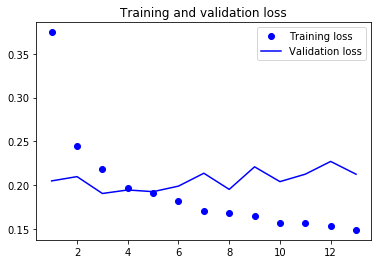
print('Model Error:', f'{((min(val_loss_lstm64) * train_mw_std)/plant_capacity):0.2%}')Model Error: 4.87%lstm64 = ((min(val_loss_lstm64) * train_mw_std)/plant_capacity) * 100
2.5.2 LSTM with 32 nodes
filepath_lstm32="Cebu_best_lstm32.hdf5"
cp_lstm32 = ModelCheckpoint(filepath_lstm32, monitor='val_loss', verbose=2, save_best_only=True, mode='min')
es_lstm32 = EarlyStopping(monitor='val_loss', mode='min', verbose=2, patience=10, min_delta=.01)
callbacks_list_lstm32 = [cp_lstm32, es_lstm32]

# fix random seed for reproducibility
seed = 1337
np.random.seed(seed)

model_lstm32 = Sequential()
model_lstm32.add(layers.LSTM(32,
                       dropout=0.2,
                       recurrent_dropout=0.2,
                       input_shape=(None, float_data.shape[-1])))
model_lstm32.add(layers.Dense(32, activation='relu'))
model_lstm32.add(layers.Dense(1))
model_lstm32.compile(optimizer=RMSprop(), loss='mae')

history_lstm32 = model_lstm32.fit_generator(train_gen,
                                        steps_per_epoch=steps_per_epoch_cnt,
                                        epochs=50,
                                        validation_data=val_gen,
                                        validation_steps=val_steps_cnt,
                                        callbacks=callbacks_list_lstm32, verbose=2)
Epoch 1/50
20/20 [==============================] - 1s 40ms/step - loss: 0.2389
Epoch 00001: val_loss improved from inf to 0.23892, saving model to Cebu_best_lstm32.hdf5
- 18s - loss: 0.4182 - val_loss: 0.2389
Epoch 2/50
20/20 [==============================] - 1s 31ms/step - loss: 0.1922
Epoch 00002: val_loss improved from 0.23892 to 0.19216, saving model to Cebu_best_lstm32.hdf5
- 16s - loss: 0.2575 - val_loss: 0.1922
Epoch 3/50
20/20 [==============================] - 1s 34ms/step - loss: 0.1897
Epoch 00003: val_loss improved from 0.19216 to 0.18967, saving model to Cebu_best_lstm32.hdf5
- 16s - loss: 0.2250 - val_loss: 0.1897
Epoch 4/50
20/20 [==============================] - 1s 33ms/step - loss: 0.1686
Epoch 00004: val_loss improved from 0.18967 to 0.16857, saving model to Cebu_best_lstm32.hdf5
- 17s - loss: 0.2017 - val_loss: 0.1686
Epoch 5/50
20/20 [==============================] - 1s 30ms/step - loss: 0.1814
Epoch 00005: val_loss did not improve from 0.16857
- 17s - loss: 0.1978 - val_loss: 0.1814
Epoch 6/50
20/20 [==============================] - 1s 36ms/step - loss: 0.1943
Epoch 00006: val_loss did not improve from 0.16857
- 16s - loss: 0.1892 - val_loss: 0.1943
Epoch 7/50
20/20 [==============================] - 1s 35ms/step - loss: 0.1845
Epoch 00007: val_loss did not improve from 0.16857
- 17s - loss: 0.1793 - val_loss: 0.1845
Epoch 8/50
20/20 [==============================] - 1s 47ms/step - loss: 0.1899
Epoch 00008: val_loss did not improve from 0.16857
- 18s - loss: 0.1751 - val_loss: 0.1899
Epoch 9/50
20/20 [==============================] - 1s 38ms/step - loss: 0.2050
Epoch 00009: val_loss did not improve from 0.16857
- 20s - loss: 0.1721 - val_loss: 0.2050
Epoch 10/50
20/20 [==============================] - 1s 32ms/step - loss: 0.1828
Epoch 00010: val_loss did not improve from 0.16857
- 17s - loss: 0.1644 - val_loss: 0.1828
Epoch 11/50
20/20 [==============================] - 1s 37ms/step - loss: 0.1875
Epoch 00011: val_loss did not improve from 0.16857
- 16s - loss: 0.1676 - val_loss: 0.1875
Epoch 12/50
20/20 [==============================] - 1s 34ms/step - loss: 0.1935
Epoch 00012: val_loss did not improve from 0.16857
- 17s - loss: 0.1646 - val_loss: 0.1935
Epoch 13/50
20/20 [==============================] - 1s 33ms/step - loss: 0.1911
Epoch 00013: val_loss did not improve from 0.16857
- 17s - loss: 0.1607 - val_loss: 0.1911
Epoch 14/50
20/20 [==============================] - 1s 35ms/step - loss: 0.1989
Epoch 00014: val_loss did not improve from 0.16857
- 17s - loss: 0.1528 - val_loss: 0.1989
Epoch 00014: early stoppingloss_lstm32 = history_lstm32.history['loss']
val_loss_lstm32 = history_lstm32.history['val_loss']
epochs = range(1, len(loss_lstm32) + 1)
plt.figure()
plt.plot(epochs, loss_lstm32, 'bo', label='Training loss')
plt.plot(epochs, val_loss_lstm32, 'b', label='Validation loss')
plt.title('Training and validation loss')
plt.legend()
plt.show()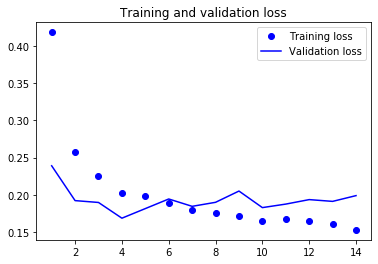
print('Model Error:', f'{((min(val_loss_lstm32) * train_mw_std)/plant_capacity):0.2%}')Model Error: 4.30%lstm32 = ((min(val_loss_lstm32) * train_mw_std)/plant_capacity) * 100
2.5.3 Stacked LSTM with 64 and 32 nodes
filepath_lstm6432="Cebu_best_lstm6432.hdf5"
cp_lstm6432 = ModelCheckpoint(filepath_lstm6432, monitor='val_loss', verbose=2, save_best_only=True, mode='min')
es_lstm6432 = EarlyStopping(monitor='val_loss', mode='min', verbose=2, patience=10, min_delta=.01)
callbacks_list_lstm6432 = [cp_lstm6432, es_lstm6432]

# fix random seed for reproducibility
seed = 1337
np.random.seed(seed)

model_lstm6432 = Sequential()
model_lstm6432.add(layers.LSTM(64,
                    dropout=0.2,
                    recurrent_dropout=0.2,
                    return_sequences=True,
                    input_shape=(None, float_data.shape[-1])))
model_lstm6432.add(layers.LSTM(32,
                    dropout=0.2,
                    recurrent_dropout=0.2))
model_lstm6432.add(layers.Dense(32, activation='relu'))
model_lstm6432.add(layers.Dense(1))
model_lstm6432.compile(optimizer=RMSprop(), loss='mae')

history_lstm6432 = model_lstm6432.fit_generator(train_gen,
                                             steps_per_epoch=steps_per_epoch_cnt,
                                             epochs=50,
                                             validation_data=val_gen,
                                             validation_steps=val_steps_cnt,
                                             callbacks=callbacks_list_lstm6432, verbose=2)
Epoch 1/50
20/20 [==============================] - 2s 93ms/step - loss: 0.2058
Epoch 00001: val_loss improved from inf to 0.20581, saving model to Cebu_best_lstm6432.hdf5
- 40s - loss: 0.3520 - val_loss: 0.2058
Epoch 2/50
20/20 [==============================] - 1s 67ms/step - loss: 0.2092
Epoch 00002: val_loss did not improve from 0.20581
- 39s - loss: 0.2220 - val_loss: 0.2092
Epoch 3/50
20/20 [==============================] - 2s 80ms/step - loss: 0.2094
Epoch 00003: val_loss did not improve from 0.20581
- 41s - loss: 0.2063 - val_loss: 0.2094
Epoch 4/50
20/20 [==============================] - 1s 61ms/step - loss: 0.1837
Epoch 00004: val_loss improved from 0.20581 to 0.18374, saving model to Cebu_best_lstm6432.hdf5
- 38s - loss: 0.1854 - val_loss: 0.1837
Epoch 5/50
20/20 [==============================] - 1s 64ms/step - loss: 0.1957
Epoch 00005: val_loss did not improve from 0.18374
- 37s - loss: 0.1823 - val_loss: 0.1957
Epoch 6/50
20/20 [==============================] - 1s 68ms/step - loss: 0.1878
Epoch 00006: val_loss did not improve from 0.18374
- 36s - loss: 0.1751 - val_loss: 0.1878
Epoch 7/50
20/20 [==============================] - 2s 76ms/step - loss: 0.1899
Epoch 00007: val_loss did not improve from 0.18374
- 39s - loss: 0.1630 - val_loss: 0.1899
Epoch 8/50
20/20 [==============================] - 1s 65ms/step - loss: 0.2210
Epoch 00008: val_loss did not improve from 0.18374
- 39s - loss: 0.1590 - val_loss: 0.2210
Epoch 9/50
20/20 [==============================] - 1s 63ms/step - loss: 0.2153
Epoch 00009: val_loss did not improve from 0.18374
- 37s - loss: 0.1539 - val_loss: 0.2153
Epoch 10/50
20/20 [==============================] - 1s 72ms/step - loss: 0.2149
Epoch 00010: val_loss did not improve from 0.18374
- 38s - loss: 0.1487 - val_loss: 0.2149
Epoch 11/50
20/20 [==============================] - 1s 64ms/step - loss: 0.2119
Epoch 00011: val_loss did not improve from 0.18374
- 36s - loss: 0.1475 - val_loss: 0.2119
Epoch 12/50
20/20 [==============================] - 1s 75ms/step - loss: 0.2246
Epoch 00012: val_loss did not improve from 0.18374
- 37s - loss: 0.1471 - val_loss: 0.2246
Epoch 13/50
20/20 [==============================] - 1s 62ms/step - loss: 0.2063
Epoch 00013: val_loss did not improve from 0.18374
- 37s - loss: 0.1418 - val_loss: 0.2063
Epoch 14/50
20/20 [==============================] - 1s 64ms/step - loss: 0.2216
Epoch 00014: val_loss did not improve from 0.18374
- 38s - loss: 0.1352 - val_loss: 0.2216
Epoch 00014: early stoppingloss_lstm6432 = history_lstm6432.history['loss']
val_loss_lstm6432 = history_lstm6432.history['val_loss']
epochs = range(1, len(loss_lstm6432) + 1)
plt.figure()
plt.plot(epochs, loss_lstm6432, 'bo', label='Training loss')
plt.plot(epochs, val_loss_lstm6432, 'b', label='Validation loss')
plt.title('Training and validation loss')
plt.legend()
plt.show()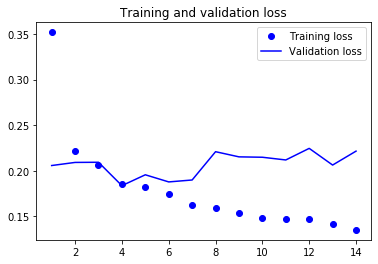
print('Model Error:', f'{((min(val_loss_lstm6432) * train_mw_std)/plant_capacity):0.2%}')Model Error: 4.69%lstm6432 = ((min(val_loss_lstm6432) * train_mw_std)/plant_capacity) * 100
2.5.4 Stacked LSTM with 32 and 64 nodes
filepath_lstm3264 ="Cebu_best_lstm3264.hdf5"
cp_lstm3264 = ModelCheckpoint(filepath_lstm3264, monitor='val_loss', verbose=2, save_best_only=True, mode='min')
es_lstm3264 = EarlyStopping(monitor='val_loss', mode='min', verbose=2, patience=10, min_delta=.01)
callbacks_list_lstm3264 = [cp_lstm3264, es_lstm3264]

# fix random seed for reproducibility
seed = 1337
np.random.seed(seed)

model_lstm3264 = Sequential()
model_lstm3264.add(layers.LSTM(64,
                    dropout=0.2,
                    recurrent_dropout=0.2,
                    return_sequences=True,
                    input_shape=(None, float_data.shape[-1])))
model_lstm3264.add(layers.LSTM(32,
                    dropout=0.2,
                    recurrent_dropout=0.2))
model_lstm3264.add(layers.Dense(64, activation='relu'))
model_lstm3264.add(layers.Dense(1))
model_lstm3264.compile(optimizer=RMSprop(), loss='mae')

history_lstm3264 = model_lstm3264.fit_generator(train_gen,
                                             steps_per_epoch=steps_per_epoch_cnt,
                                             epochs=50,
                                             validation_data=val_gen,
                                             validation_steps=val_steps_cnt,
                                             callbacks=callbacks_list_lstm3264, verbose=2)
Epoch 1/50
20/20 [==============================] - 1s 71ms/step - loss: 0.1866
Epoch 00001: val_loss improved from inf to 0.18658, saving model to Cebu_best_lstm3264.hdf5
- 38s - loss: 0.3441 - val_loss: 0.1866
Epoch 2/50
20/20 [==============================] - 1s 63ms/step - loss: 0.2028
Epoch 00002: val_loss did not improve from 0.18658
- 34s - loss: 0.2206 - val_loss: 0.2028
Epoch 3/50
20/20 [==============================] - 1s 68ms/step - loss: 0.2007
Epoch 00003: val_loss did not improve from 0.18658
- 36s - loss: 0.2065 - val_loss: 0.2007
Epoch 4/50
20/20 [==============================] - 1s 70ms/step - loss: 0.2070
Epoch 00004: val_loss did not improve from 0.18658
- 38s - loss: 0.1875 - val_loss: 0.2070
Epoch 5/50
20/20 [==============================] - 1s 74ms/step - loss: 0.2092
Epoch 00005: val_loss did not improve from 0.18658
- 37s - loss: 0.1841 - val_loss: 0.2092
Epoch 6/50
20/20 [==============================] - 1s 63ms/step - loss: 0.1759
Epoch 00006: val_loss improved from 0.18658 to 0.17589, saving model to Cebu_best_lstm3264.hdf5
- 36s - loss: 0.1766 - val_loss: 0.1759
Epoch 7/50
20/20 [==============================] - 1s 65ms/step - loss: 0.1925
Epoch 00007: val_loss did not improve from 0.17589
- 37s - loss: 0.1656 - val_loss: 0.1925
Epoch 8/50
20/20 [==============================] - 1s 64ms/step - loss: 0.1958
Epoch 00008: val_loss did not improve from 0.17589
- 37s - loss: 0.1625 - val_loss: 0.1958
Epoch 9/50
20/20 [==============================] - 1s 63ms/step - loss: 0.1980
Epoch 00009: val_loss did not improve from 0.17589
- 35s - loss: 0.1564 - val_loss: 0.1980
Epoch 10/50
20/20 [==============================] - 1s 63ms/step - loss: 0.2024
Epoch 00010: val_loss did not improve from 0.17589
- 34s - loss: 0.1515 - val_loss: 0.2024
Epoch 11/50
20/20 [==============================] - 1s 65ms/step - loss: 0.1945
Epoch 00011: val_loss did not improve from 0.17589
- 35s - loss: 0.1507 - val_loss: 0.1945
Epoch 12/50
20/20 [==============================] - 1s 64ms/step - loss: 0.2235
Epoch 00012: val_loss did not improve from 0.17589
- 37s - loss: 0.1500 - val_loss: 0.2235
Epoch 13/50
20/20 [==============================] - 1s 64ms/step - loss: 0.2137
Epoch 00013: val_loss did not improve from 0.17589
- 38s - loss: 0.1436 - val_loss: 0.2137
Epoch 14/50
20/20 [==============================] - 1s 65ms/step - loss: 0.2093
Epoch 00014: val_loss did not improve from 0.17589
- 37s - loss: 0.1375 - val_loss: 0.2093
Epoch 15/50
20/20 [==============================] - 1s 68ms/step - loss: 0.2092
Epoch 00015: val_loss did not improve from 0.17589
- 40s - loss: 0.1401 - val_loss: 0.2092
Epoch 16/50
20/20 [==============================] - 1s 64ms/step - loss: 0.1887
Epoch 00016: val_loss did not improve from 0.17589
- 37s - loss: 0.1418 - val_loss: 0.1887
Epoch 00016: early stoppingloss_lstm3264 = history_lstm3264.history['loss']
val_loss_lstm3264 = history_lstm3264.history['val_loss']
epochs = range(1, len(loss_lstm3264) + 1)
plt.figure()
plt.plot(epochs, loss_lstm3264, 'bo', label='Training loss')
plt.plot(epochs, val_loss_lstm3264, 'b', label='Validation loss')
plt.title('Training and validation loss')
plt.legend()
plt.show()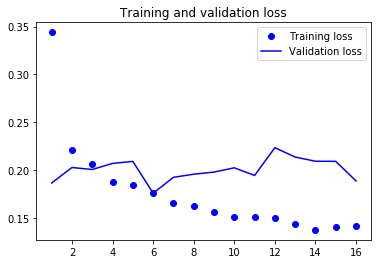
print('Model Error:', f'{((min(val_loss_lstm3264) * train_mw_std)/plant_capacity):0.2%}')Model Error: 4.49%lstm3264 = ((min(val_loss_lstm3264) * train_mw_std)/plant_capacity) * 100lstm32640.0448781794602682
3. Results and Discussions
3.1 Results
names = ['Industry Agnostic Naive Method',
         'Industry Standard Naive Method',
         'LSTM with 64 nodes',
         'LSTM with 32 nodes',
         'LSTM+LSTM with 64 nodes and 32 nodes',
         'LSTM+LSTM with 32 nodes and 64 nodes']
results = [benchmark1,
           benchmark2,
           lstm64,
           lstm32,
           lstm6432,
           lstm3264]
results = pd.DataFrame(zip(names,results), columns=['Model', 'Error in Percentage'])results['Error in Percentage'] = round(results['Error in Percentage'],2)results['Improvement'] = round(1-(results['Error in Percentage']/benchmark2),4)*100results| Model | Error in Percentage | Improvement | |
|---|---|---|---|
| 0 | Industry Agnostic Naive Method | 7.67 | 50.00 |
| 1 | Industry Standard Naive Method | 15.34 | 0.00 |
| 2 | LSTM with 64 nodes | 4.87 | 68.25 |
| 3 | LSTM with 32 nodes | 4.30 | 71.97 |
| 4 | LSTM+LSTM with 64 nodes and 32 nodes | 4.69 | 69.43 |
| 5 | LSTM+LSTM with 32 nodes and 64 nodes | 4.49 | 70.73 |